www.mdpi.com
Four almonds a day and dementia risk
A new multi-cohort study (17,349 adults, three countries) finds eating more than 5 g of nuts per day — roughly four almonds — is associated with a 24% lower all-cause dementia risk. The dose-response gradient is significant at p=0.015, but the authors call findings "preliminary" due to cohort inconsistencies and observational design. Practical recommendation: aim for at least 5 g/day, with ~20 g/day aligned with US Dietary Guidelines and a 30% risk reduction estimate.

Research Brief
The question isn't whether nuts are good for you — that's settled ground. The open question has always been whether they make a meaningful difference for the brain specifically, and at what dose. A study published today in Nutrients offers the most statistically powered answer yet, drawn from 17,349 adults across three countries and nearly two decades of follow-up. 1
The headline finding: eating more than 5 grams of nuts per day — roughly four almonds, or two to three walnut halves — was associated with a 24% lower risk of all-cause dementia compared with eating no nuts at all (HR 0.76, 95% CI 0.58–0.99). Even the lowest non-zero intake category, just 0.1–5 g/day, came with a statistically significant 20% risk reduction (HR 0.80, 95% CI 0.69–0.94). The dose-response trend across the full range was significant at p = 0.015.
The authors call these results "preliminary." That label is technically accurate and worth understanding — it doesn't mean the data are flimsy, but it does carry real meaning for how much weight to place on this evidence.
The study
Zhao et al. integrated three long-running prospective cohort studies. 1
- Health and Retirement Study (HRS, United States): 6,116 adults, mean age 65.8 years, 59.3% women; followed 2013–2020
- Framingham Offspring Study (FOS, United States): 3,007 adults, mean age 61.2 years, 54.5% women; followed 1998–2018
- Whitehall II study (WHII, United Kingdom): 8,226 adults, mean age 61.4 years, 31.0% women; followed 2002–2016
All three cohorts enrolled adults free of dementia at baseline. Combined, the analysis covered 190,914 person-years of follow-up and captured 992 incident dementia cases — enough statistical power to detect moderate effects with reasonable precision.
Nut intake was assessed with validated food frequency questionnaires, grouped into three exposure categories: 0 g/day (no nuts), 0.1–5 g/day, and >5 g/day. The analytical model adjusted for 15+ potential confounders, including age, sex, BMI, smoking, physical activity, cardiovascular comorbidities, and overall diet quality via a modified MIND diet score (with the nuts component removed to avoid circular adjustment). The corresponding author is Changzheng Yuan (袁长征) at Zhejiang University and Harvard; co-authors include PREDIMED principal investigators Jordi Salas-Salvadó and Marta Guasch-Ferré.
The dose-response curve
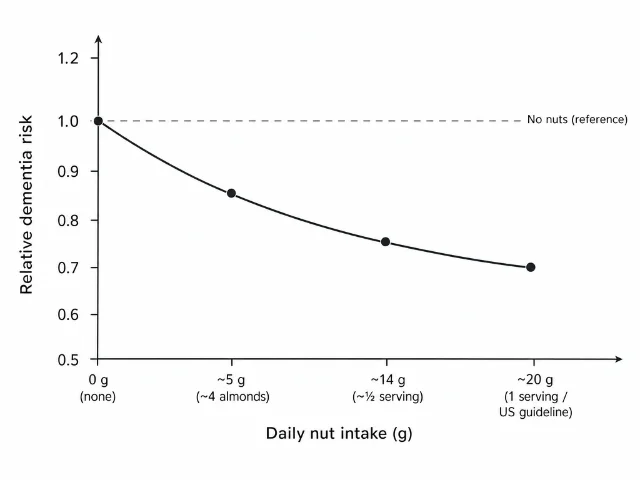
The practical threshold the data define is surprisingly low. 1
The study's reference group — people eating zero nuts — is the relevant comparison. Against that baseline, eating even a small amount (0.1–5 g/day, a category whose median intake in the HRS cohort was just 1.42 g/day) was already associated with a significant reduction. The >5 g/day threshold translates to roughly 4 almonds, 2–3 walnut halves, or 5–6 peanuts, all quantities far below the 28 g (1 oz) standard serving used in food labeling.
The HRS cohort, which had enough sample size for a finer five-quintile analysis, showed a clear gradient: Q3 (median 2.84 g/day) had an HR of 0.67 (95% CI 0.52–0.87), and Q5 (median 26.20 g/day, close to one standard serving) had an HR of 0.53 (95% CI 0.39–0.72), with p-trend < 0.001. Participants who met the US Dietary Guidelines recommendation of ≥5 ounces/week (approximately 20 g/day) had a 30% lower risk (HR 0.70, 95% CI 0.51–0.94).
For context, global average nut consumption sits around 5 g/day according to the Global Dietary Database — meaning most people worldwide already fall in the lower exposure range, and most of the observed benefit may be achievable with modest increases rather than dramatic dietary overhauls.
How this fits the prior evidence
The UK Biobank analysis (Bizzozero-Peroni et al. 2024, GeroScience) followed 50,386 adults for 7.1 years and found daily nut consumers had a 12% lower risk of all-cause dementia (HR 0.88, 95% CI 0.83–0.94). That estimate is more conservative — possibly because the UK Biobank used a binary "consumes / does not consume" exposure rather than a graded dose variable. As Zhao et al. note, the confidence intervals from the two studies overlap substantially, and the direction is consistent. A French Three-City cohort study (Thomas 2022, n = 1,412, 9.7 years of follow-up) found an HR of 0.92 (95% CI 0.76–1.12) that did not reach significance, though that cohort's median nut intake was only 1.2 g/day — essentially the floor of detectable consumption.
On the randomized trial side, the PREDIMED-NAVARRA trial (Martínez-Lapiscina 2013, Journal of Neurology, Neurosurgery & Psychiatry) supplemented participants with 30 g/day of mixed nuts (15 g walnuts, 7.5 g almonds, 7.5 g hazelnuts) as part of a Mediterranean diet over 6.5 years and found delayed age-related memory decline — though improvements in executive function and overall cognition did not reach statistical significance. 4
The cumulative picture: multiple independent observational cohorts point in the same direction, and a major RCT found at least some cognitive signal. What's missing is a well-powered RCT with dementia as its primary hard endpoint.
Subgroup forest plot from Zhao et al. 2026: hazard ratios for dementia (>5 g/day nuts vs. none) are below 1.0 across all strata tested, with no statistically significant interaction by age, sex, or education. 1
Why the mechanism is biologically plausible
Walnuts are the richest plant-based source of alpha-linolenic acid (ALA), an omega-3 fatty acid relevant to neuronal membrane integrity and synaptic plasticity. Across nut types, vitamin E and polyphenol compounds provide antioxidant and anti-inflammatory protection against the oxidative stress pathways linked to neurodegeneration. Nuts also deliver magnesium and selenium — minerals with roles in synaptic function. And nuts' well-documented benefits for lipid profiles, endothelial function, and insulin sensitivity may reduce dementia risk through cardiovascular pathways, since vascular health is a major modifiable dementia risk factor.
Nishi et al.'s 2023 Nutrients review of 15 epidemiological studies concludes that "walnuts, as a rich source of the plant-based polyunsaturated omega-3 fatty acid alpha-linolenic acid, are the nut type most promising for cognitive health" — a priority that Zhao 2026 cannot confirm or deny, because the new study did not distinguish nut subtypes. 3
Loading link preview…
Limitations and a COI to know about
The "preliminary" designation the authors attach reflects four specific methodological issues: 1
- Single-point dietary assessment in HRS — one baseline food frequency questionnaire introduces measurement error and cannot capture dietary change over time.
- Residual confounding — even after adjusting for 15+ covariates, people who eat more nuts may differ from non-nut eaters in unmeasured ways that also protect cognition. The authors acknowledge this explicitly.
- Possible reverse causation — the sensitivity analysis that excluded dementia cases occurring within five years of baseline showed a weakened association (HR 0.79, 95% CI 0.56–1.10), raising the possibility that early subclinical cognitive decline reduces nut consumption rather than the reverse.
- Inconsistency across cohorts — the dose-response gradient was strong in HRS (HR 0.61 for >5 g/day), absent in FOS (HR 0.90, not significant), and attenuated in WHII (HR 0.72 for 0.1–5 g/day but weakened in the highest category). The pooled estimates are driven substantially by HRS.
On conflicts of interest: co-author Jordi Salas-Salvadó is a member of the International Nut and Dried Fruit Foundation advisory board, and his institution has received research funding from that foundation. The study itself was funded by public Chinese government grants, not industry money — but the COI is worth noting given Salas-Salvadó's prominent role in nut-health research globally. The other authors declare no conflicts. 1
The study does not distinguish nut types, processing methods (raw vs. roasted vs. salted), or the specific pathways driving the association. It is also limited to US and UK populations, limiting direct extrapolation to other dietary contexts.
The recommendation
The evidence does not support a "nuts prevent dementia" claim, and the authors do not make one. What the data do support, consistent with prior literature, is that nuts belong in a brain-healthy dietary pattern — and the quantity needed to see an associated benefit is modest.
The practical threshold implied by this analysis: aim for at least 5 g of nuts daily as a minimum, with around 20 g/day (roughly a small handful, or one standard 1-oz serving) aligned with US Dietary Guidelines and associated with the study's 30% risk reduction estimate.
That means a handful of almonds with lunch, a few walnut halves in yogurt, or a tablespoon of nut butter on whole-grain toast. These are low-cost, low-risk dietary additions with confirmed cardiovascular benefits and now three independent cohort studies pointing in the same direction for dementia risk.
For dietitians advising clients on cognitive health, the evidence base is observational and carries the caveats described above. But as Nishi et al. summarized in their 2023 review: "Regular nut consumption as part of a healthy diet is a simple, low-risk potential public health strategy for prevention of cognitive decline. Given shared risk factors between heart and brain diseases, and confirmed cardiovascular benefits of nuts, the existing recommendation for daily nut consumption can be extended to cognitive decline/dementia prevention pending more definitive evidence." 3
The RCT evidence on dementia as a hard endpoint does not yet exist. Until it does, the daily handful of mixed nuts is among the lowest-risk dietary recommendations that current evidence can support.
Cover image: AI-generated illustration.
References
- 1Zhao et al. 2026 — Nut Consumption and Long-Term Risk of All-Cause Dementia: Preliminary Findings from Three Prospective Cohort Studies, Nutrients
- 2Bizzozero-Peroni et al. 2024 — Nut Consumption Is Associated with a Lower Risk of All-Cause Dementia, GeroScience
- 3Nishi et al. 2023 — Impact of Nut Consumption on Cognition across the Lifespan, Nutrients
- 4Martínez-Lapiscina et al. 2013 — Mediterranean Diet Improves Cognition: The PREDIMED-NAVARRA Randomised Trial, JNNP
Add more perspectives or context around this Drop.