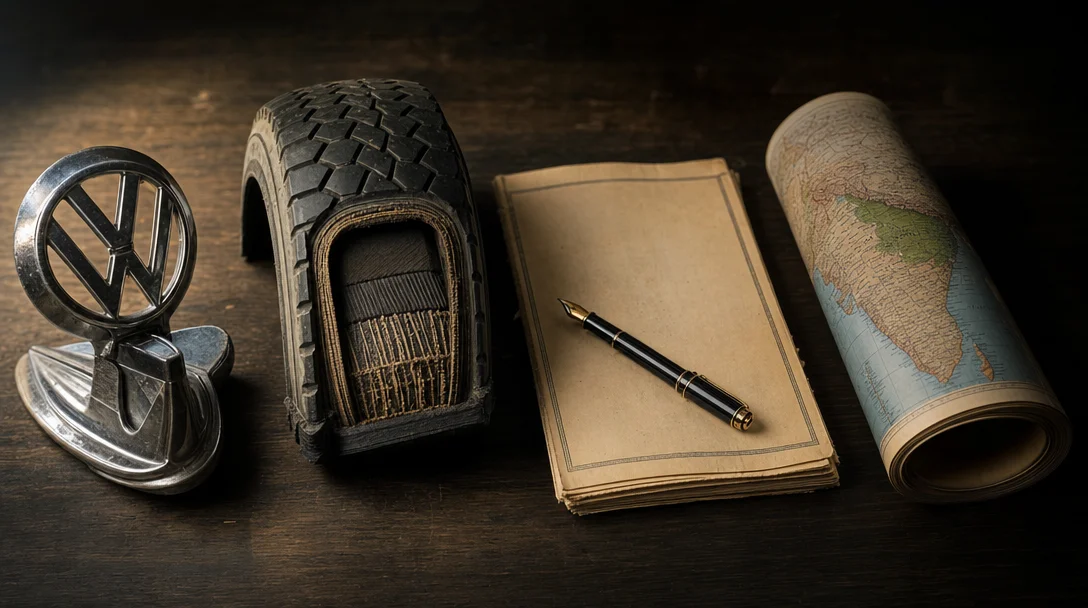
May 28: a people's car, a tire company's accidental empire, a minnow swallowing a whale, and a prime minister's choice
Four May 28 decisions across 109 years: Michelin incorporates in 1889 and invents restaurant ratings to sell more tires; Walter Chrysler acquires Dodge Brothers for $170M in 1928 — three times his own company's size — and creates the Detroit Big Three; Nazi Germany founds Volkswagen in 1937, which survives total defeat to become the world's largest automaker before a $33.3B emissions fraud; and Pakistan detonates five nuclear devices in 1998, choosing sovereignty over Clinton's incentive package and spending a generation in IMF programs.
Four decisions on this date — a Nazi labor organization founding a car company it could never actually sell; a provincial French rubber shop incorporating itself into what would become the world's most powerful restaurant brand; a railroad machinist's firm buying a company three times its size and inventing the Detroit Big Three; and a prime minister ignoring four phone calls from the US president to detonate five nuclear devices and spend a generation paying for it.
1889 — Édouard and André Michelin reincorporate a struggling rubber factory
The Barbier-Daubrée rubber factory in Clermont-Ferrand had been producing rubber valves, brake pads, and gaskets for farm machinery since 1832 1. On May 28, 1889, brothers Édouard and André Michelin formally reincorporated it as Michelin & Cie 2. Édouard was the engineer; André, a former government cartographer, handled marketing. The story that crystallized their direction: a cyclist arrived at the factory needing a pneumatic tire repair. The tire was glued to the rim. Removing it took more than three hours and required overnight drying for the adhesive. Édouard tested the repaired tire the next day; it failed within a few hundred meters 1.
Two years later, Michelin filed its first patent for a removable pneumatic bicycle tire — one that could be changed roadside without tools, glue, or overnight waiting. To prove the point publicly, they entered cyclist Charles Terront in the 1891 Paris-Brest-Paris race, a 1,200-kilometer endurance event. Terront won, completing the course in approximately 71 hours 1. By 1895 they had applied the concept to motor vehicles, fitting pneumatic tires to a car called L'Éclair for the Paris-Bordeaux-Paris race.
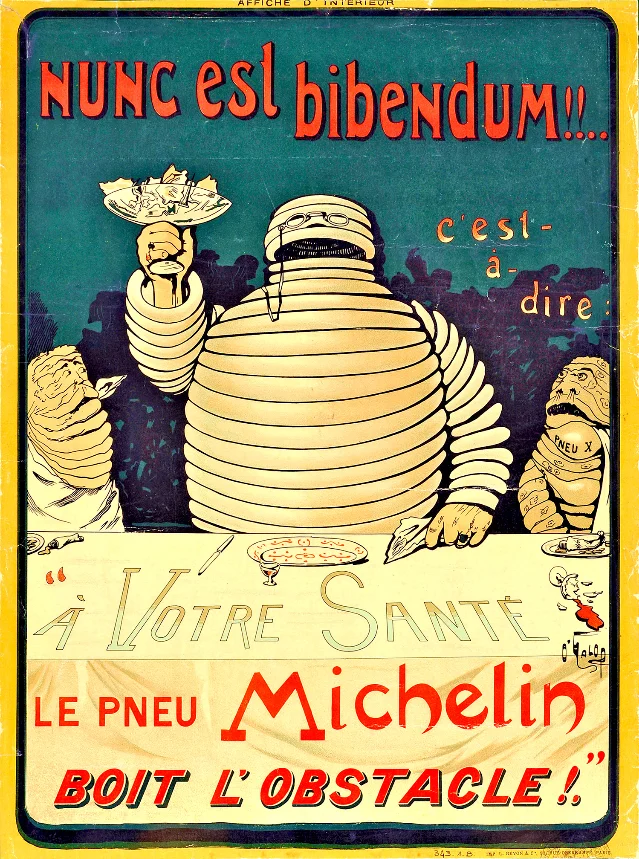
André Michelin understood early that selling tires meant first multiplying the number of cars on French roads — fewer than 3,000 existed when the first Michelin Guide was printed in 1900 as a free pocket-sized booklet 4. The guide told motorists where to find gasoline (sold at pharmacies in liter containers), included sunset timetables, listed hotels, and devoted its first 33 pages to tire care. André wrote in the introduction: "This work comes out with the century; it will last as long." 5 Nearly 35,000 copies were distributed in that first edition 4.
The guide went to a paid model in the early 1920s after André found copies being used to prop up a garage workbench — "man only truly respects what he pays for," he said 4. The single-star restaurant rating arrived in 1926, the three-star hierarchy in 1931 4. By the time Michelin patented the radial tire in 1946 — its most significant engineering contribution, offering superior fuel economy, handling, and tread life over the bias-ply tires that held 87% of the US market as late as 1967 — the company was already something unusual: an industrial firm that had accidentally constructed a parallel cultural authority 1.
The radial's US breakthrough came through a 1966 partnership with Sears, selling under the Allstate brand. By 1970, Michelin was producing 1 million radials annually for the American market 1. Michelin acquired B.F. Goodrich and Uniroyal's tire divisions in 1989 and is the world's largest tire manufacturer by revenue since 2021, with €28.6 billion in revenue in 2022 and 132,000 employees 1.
Mirror: Michelin's guide was not a content strategy pivot — it was tire marketing using the cheapest lever available: print. The company had no car market to sell into until it helped build one by making cars more useful and roads more legible. André Michelin's real insight was that demand creation and demand capture are not separate functions. Businesses that sell enabling technologies (infrastructure, platforms, components) have a structural reason to invest in expanding the ecosystem they depend on. The restaurant guide's authority today — which cities pay up to $4.4 million for Michelin Guide coverage 6 — is an artifact of a tire company that needed more people to own cars in 1900.
1928 — Walter Chrysler buys a company three times his own size
The Dodge brothers — Horace and John, Detroit machinists — had started by manufacturing precision parts for Oldsmobile and Ford 7. In 1903, Henry Ford paid them $10,000 in parts, plus a 10% equity stake in Ford Motor Company, in exchange for supplying engines, transmissions, and axles for the Model T 7. By 1914, they had used the Ford relationship to understand the car business well enough to launch their own vehicle — the Dodge Model 30-35 touring car, with a full-steel body (most cars still used wood frames), a 12-volt electrical system (industry standard was 6 volts until the 1950s), and a 35-horsepower engine against the Model T's 20 7. John Dodge summed up their positioning: "Someday, people who own a Ford are going to want an automobile." 7
By 1916 Dodge was America's second-largest automaker, behind only Ford 7. Then both brothers died in 1920 — John from pneumonia (a complication of the 1918 Spanish flu) in January, Horace from cirrhosis in December 7. Their widows ran the company for five years before selling to New York investment bank Dillon, Read & Co. in 1925 for $146 million — the largest cash transaction in US history at the time 7. Dillon Read promptly appointed a banker with no automotive experience as board chairman. Dodge's sales rank collapsed from fifth to thirteenth 7.
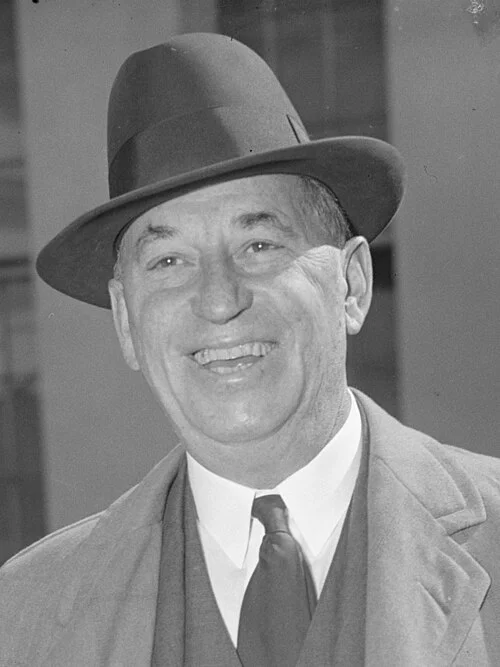
Walter Chrysler had risen from railroad machinist to president of Buick, left General Motors over a dispute with founder William Durant, pocketed $10 million in GM stock, and in 1921 taken over a failing car company called Maxwell, renaming it Chrysler Corporation in 1925 8. On May 28, 1928, Chrysler bought Dodge Brothers from Dillon Read for $170 million in stock — acquiring a company roughly three times Chrysler's own size 7 9. What he was paying for was operational: the Dodge Main plant in Hamtramck, Michigan, then the largest automobile factory in the world; a national dealer network of approximately 4,000 locations; and a brand working-class Americans already trusted 9.
That same year, Chrysler launched Plymouth (low-end) and DeSoto (mid-range), completing a four-rung brand ladder — Plymouth, Dodge, DeSoto, Chrysler — that mirrored Alfred Sloan's GM strategy 10. Chrysler was named Time magazine's Man of the Year for 1928 8. By 1936 the company was America's second-largest automaker, a position it held until 1949 9.
The subsequent 98-year arc involved three near-death episodes. In 1979 the company lost $1.1 billion and CEO Lee Iacocca (who had been fired by Ford) persuaded Congress to back a $1.5 billion federal loan guarantee — repaid seven years early, with the US government netting $350 million 9. In 1998, Daimler-Benz merged with Chrysler in a transaction called a "merger of equals" valued at $38 billion — at the time the largest cross-border acquisition globally — but investors later won a $300 million lawsuit arguing it was a takeover in disguise; Daimler sold Chrysler for $7.4 billion in 2007, less than a fifth of what it had paid 11. In 2009, Chrysler filed Chapter 11 bankruptcy and received $12.5 billion in government TARP funds; US taxpayers ultimately lost $1.3 billion on the rescue 9. Chrysler today exists as a reduced brand inside Stellantis N.V. — the 14-brand conglomerate formed by Fiat Chrysler and France's PSA Group in 2021 — where the previous CEO resigned in December 2024 after profits fell 70%. The new CEO, Antonio Filosa, was appointed on May 28, 2025, the acquisition's 97th anniversary 12.
Mirror: Chrysler's 1928 deal was structurally sound: acquire capabilities your company cannot build fast enough on its own — factory capacity, distribution reach, brand equity — by buying a well-run company whose owner doesn't know the business. Dillon Read's mismanagement had depressed the price; Chrysler's operational capability immediately reversed the sales decline. The 1998 Daimler deal is the mirror of that: a financially engineered "merger of equals" that obscured actual power dynamics, produced a cultural collision, destroyed value, and required litigation to name what it actually was. The 1928 deal was honest about what each party was getting. The 1998 deal was not.
1937 — The German Labour Front founds a car company that fails to sell a single car to its subscribers
On May 28, 1937, the German Labour Front — the Nazi Party's national labor organization — founded a company in Berlin under the name Gesellschaft zur Vorbereitung des Deutschen Volkswagens mbH (Gezuvor), with Ferdinand Porsche as chief designer 13. The project had begun three years earlier: at a 1934 meeting at Berlin's Kaiserhof Hotel, Adolf Hitler specified a car that could carry two adults and three children at 100 km/h, powered by an air-cooled engine, priced at 990 Reichsmarks (roughly €4,700 in 2021 currency) 13. Ferdinand Porsche received the development contract on June 22, 1934 13. The designer team included Erwin Komenda (body), Josef Kales (engine), Karl Rabe (chief engineer), and Franz Xaver Reimspiess, who designed the VW badge 13.
A savings scheme launched for workers: "Save five marks a week to drive your own car." Approximately 336,000 Germans enrolled and made regular deposits 13. When World War II began in 1939, every car saved for was still sitting as undelivered promises. The factory — built near a purpose-built town initially called Stadt des KdF-Wagens, later renamed Wolfsburg — pivoted entirely to military production: the Kübelwagen (Type 82) and amphibious Schwimmwagen (Type 166), both derived mechanically from the Beetle platform 13. Volkswagen admitted in 1998 that it used approximately 15,000 slave laborers during the war; German historians estimate 80% of the wartime workforce was forced labor from concentration camps 13. The factory was heavily bombed by Allied air raids.
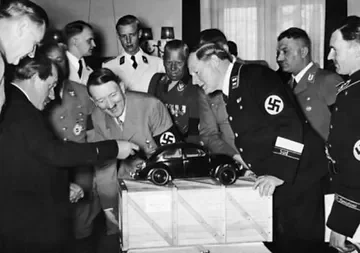
In April 1945, the bombed factory was captured by US forces and handed to the British. Major Ivan Hirst of the British Army's REME unit took command, had an abandoned KdF-Wagen repainted and demonstrated to British Army headquarters, and secured an order for 20,000 vehicles — saving the factory from dismantlement as war reparations 13. In March 1948 the British offered Volkswagen to Ford free of charge. Ford executive vice president Ernest Breech told Henry Ford II: "Mr. Ford, I don't think what we're being offered here is worth a damn." 13 Ford passed. Sir William Rootes of the Rootes Group told Hirst: "If you think you're going to build cars in this place, you're a bloody fool, young man." 13 The official British technical report concluded the Beetle was "completely uneconomic" to produce commercially.
Under managing director Heinrich Nordhoff (appointed 1948, formerly a senior Opel manager), the one-millionth Beetle was produced by 1955 13. In 1959, the New York advertising agency Doyle Dane Bernbach — working with art director Helmut Krone and copywriter Julian Koenig — created the "Think Small" campaign: white space, a tiny car, self-deprecating copy, sans-serif type. Ad Age later voted it the best advertising campaign of the 20th century 14. On February 17, 1972, the 15,007,034th Beetle rolled off the line, surpassing the Ford Model T as the world's best-selling car — a record the Model T had held for nearly 50 years 15. Total production reached 21,529,464 when the platform ended on July 30, 2003 — a 65-year production run, the longest of any single automobile generation 15.
VW's later acquisitions — Audi (via Auto Union, 1964), SEAT (1986), Škoda (1991), Bentley, Lamborghini, and Bugatti (all 1998), and Porsche (2012) — built a 12-brand empire with €325 billion in revenue and 9.03 million vehicle deliveries in 2024 16. In September 2015 the EPA issued a Notice of Violation revealing that VW had installed "defeat device" software in approximately 482,000 US diesel vehicles, causing real-world nitrogen-oxide emissions up to 40 times the legal limit 17. Total Dieselgate costs reached $33.3 billion by June 2020, including a $2.8 billion criminal fine, a $14.7 billion US civil settlement, and the resignation and subsequent indictment of CEO Martin Winterkorn 17. VW has committed $86 billion to EV development; its China market share fell from 19% in 2019 to 14.5% in 2024 under pressure from BYD and Chinese EV makers 16. In October 2024, VW announced plans to close at least three German factories — the first plant closures in the company's German history 13.
The 336,000 savings-scheme depositors who never received their promised People's Car received a 1950 settlement: a 12% discount on a new Volkswagen or roughly a 20% refund of their deposits 13.
Mirror: The company that every expert in 1948 declared worthless became the world's largest automaker — by revenue — through a combination of a major power's occupation order, one British Army officer's instinct, and a managing director who understood that engineering clarity and honest pricing could sell cars in a bombed-out country with no purchasing power. The Dieselgate scandal 67 years later is the structurally identical story in reverse: the institution that had been rescued by transparency chose systemic deception to protect a product category, and paid $33.3 billion for it. The lesson is not that integrity is always rewarded — VW's wartime slave labor and founding patron should settle that — but that institutions capable of institutional deception at scale will eventually pay the cost of the exposure, and the cost is rarely proportional to the original benefit.
1998 — Nawaz Sharif orders five nuclear detonations and loses his government 17 months later
India had tested five nuclear devices at the Pokhran Test Range in Rajasthan on May 11–13, 1998, under Operation Shakti (Pokhran-II), including a claimed thermonuclear device 18. Prime Minister Atal Bihari Vajpayee declared India a nuclear state. The United States immediately imposed sanctions under the 1994 Nuclear Proliferation Prevention Act (Glenn Amendment): all non-humanitarian aid suspended, defense exports banned, US credit and credit guarantees terminated, and the US required to oppose IMF and World Bank lending to India 18. Japan froze all new loans and grants 18.
Pakistan's Finance Minister Sartaj Aziz was the only cabinet member who argued against responding in kind, citing Pakistan's low foreign exchange reserves and the certainty of further sanctions 19. US President Bill Clinton called Pakistani Prime Minister Nawaz Sharif four times between May 13 and May 27 — the final call was described by White House spokesman Mike McCurry as "very intense," lasting 25 minutes 20. Clinton's offer reportedly included delivery of 28 F-16 jets worth approximately $600 million that Pakistan had already paid for, repeal of the Pressler Amendment sanctions, and additional economic aid 20.
On May 18, Sharif summoned Pakistan Atomic Energy Commission Chairman Dr. Ishfaq Ahmad and gave the order: "Dhamaka kar dein" — "Conduct the explosion" 19.
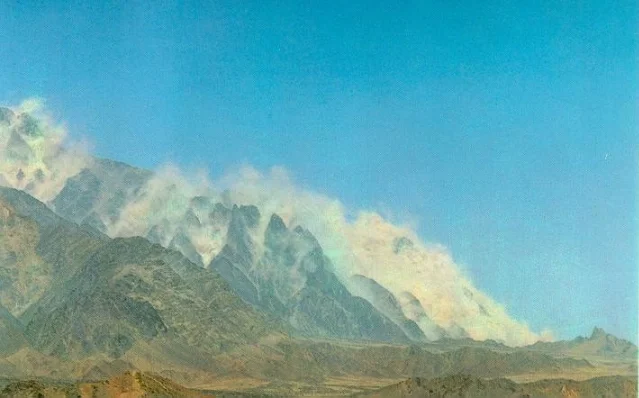
At 15:15 PKT on May 28, 1998, five nuclear devices detonated simultaneously in a one-kilometer L-shaped tunnel under Koh Kambaran in the Ras Koh Hills, Chagai District, Balochistan. The PAEC (Pakistan Atomic Energy Commission) claimed a total yield of approximately 40 kilotons; independent seismic estimates put the yield at 6–20 kilotons 19. Sharif addressed the nation: "Today, we have settled a score and have carried out five successful nuclear tests." 20 Pakistan became the seventh country to publicly test nuclear weapons and the first in the Muslim world.
The US imposed mandatory sanctions under the Glenn Amendment within hours 19. Japan — Pakistan's largest bilateral aid donor — froze all yen loans 19. Australia, Sweden, Canada, and the IMF followed with aid freezes or suspensions 19. President Rafiq Tarar declared a state of emergency to protect Pakistan's currency 19; Sharif froze foreign exchange reserves to prevent capital flight 21. The UN Security Council unanimously adopted Resolution 1172 on June 6, 1998, condemning both countries' tests and demanding cessation of their nuclear programs 22.
By October 1999, when General Pervez Musharraf overthrew Sharif in a military coup, Pakistan's foreign exchange reserves had fallen to approximately $1.2 billion — barely weeks of import cover 23. Pakistan's GDP growth had averaged around 4% for the 1990s decade; poverty had risen from 18% to 34% 23. Sharif was convicted, sentenced to life imprisonment, and eventually exiled to Saudi Arabia.
The sanctions were lifted permanently after September 11, 2001, when Pakistan became a frontline state in the US War on Terror. Between 2002 and 2011, approximately $18 billion in US military and economic aid was approved for Pakistan 24. Under Musharraf, foreign exchange reserves rebuilt from $1.2 billion to approximately $16 billion by 2007 23. Pakistan's nuclear arsenal has grown to an estimated 170 warheads as of 2025 — one of the fastest-growing arsenals globally 25. The country remains in recurring IMF programs: in 2008 ($7.6 billion), 2013 ($6.3 billion), 2019 ($6 billion), and 2023 ($3 billion standby) 23. May 28 is now Youm-e-Takbir — a national holiday 26.
India's larger and more diversified economy absorbed the same wave of sanctions with far less relative damage; US nuclear sanctions on India were largely waived by 2000–2001 18.
Mirror: Sharif's decision was domestically rational and strategically costly. The domestic pressure to respond was overwhelming — the military, public opinion, and the opposition all demanded it; Finance Minister Aziz was the single dissenting voice. But Carey Sublette, writing for the Nuclear Weapon Archive, noted that if Pakistan had declined to test, it "would have climbed dramatically" in standing as the responsible party 20. What followed instead was a generation of IMF dependency traceable directly to the sanctions cascade. The pattern that repeats across the four decades since: when the economic pain eased (post-9/11), the structural reforms that would have broken the cycle did not materialize. The nuclear deterrent Pakistan gained is real. So is the $3 billion standby arrangement it signed with the IMF in 2023. Both are consequences of the same decision.
Cover image: AI-generated editorial illustration.
References
- 1Wikipedia: Michelin
- 2Britannica: Michelin
- 3Michelin: History of the Michelin Man
- 4Wikipedia: Michelin Guide
- 5Priceonomics: Why Does a Tire Company Publish the Michelin Guide?
- 6CNN: Michelin Guide history
- 7Wikipedia: Dodge
- 8Wikipedia: Walter Chrysler
- 9Wikipedia: Chrysler
- 10Wikipedia: History of Chrysler
- 11Wikipedia: DaimlerChrysler
- 12Wikipedia: Stellantis
- 13Wikipedia: Volkswagen
- 14Wikipedia: Think Small
- 15Wikipedia: Volkswagen Beetle
- 16Wikipedia: Volkswagen Group
- 17Wikipedia: Volkswagen emissions scandal
- 18Wikipedia: Pokhran-II
- 19Wikipedia: Chagai-I
- 20Nuclear Weapon Archive: Pakistan's Nuclear Weapons Program
- 21Wikipedia: Nawaz Sharif
- 22Wikipedia: United Nations Security Council Resolution 1172
- 23Wikipedia: Economic history of Pakistan
- 24Wikipedia: Foreign aid to Pakistan
- 25Wikipedia: Pakistan and weapons of mass destruction
- 26Wikipedia: Youm-e-Takbir
Add more perspectives or context around this Drop.