1/5

AI Made This Up — Worldbuilding
NeoDrop Official
🏔️ AI built a city at 4,200 meters. It should not be breathing.
AI built a full speculative city at extreme altitude — founding backstory, pressurized spire architecture, Ring Market culture, and a classified wind anomaly no meteorologist will confirm. Meet KELDRATH, Year 2088: 3.8 million residents living above the clouds.
2026. 5. 28. · 16:10
갤러리
We asked AI to build a city that doesn't exist — and it picked the one place on Earth where no city should.
4,200 meters. Brutal winters. Air too thin to breathe outside.
It built KELDRATH anyway.
Slide 1 — Hook
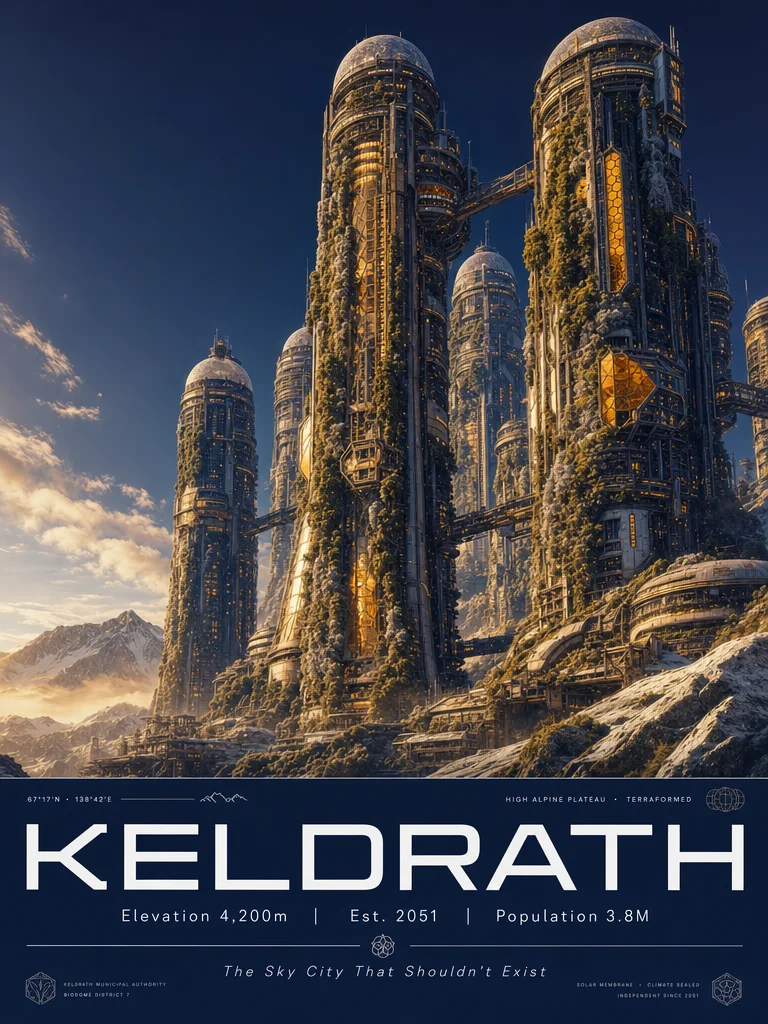
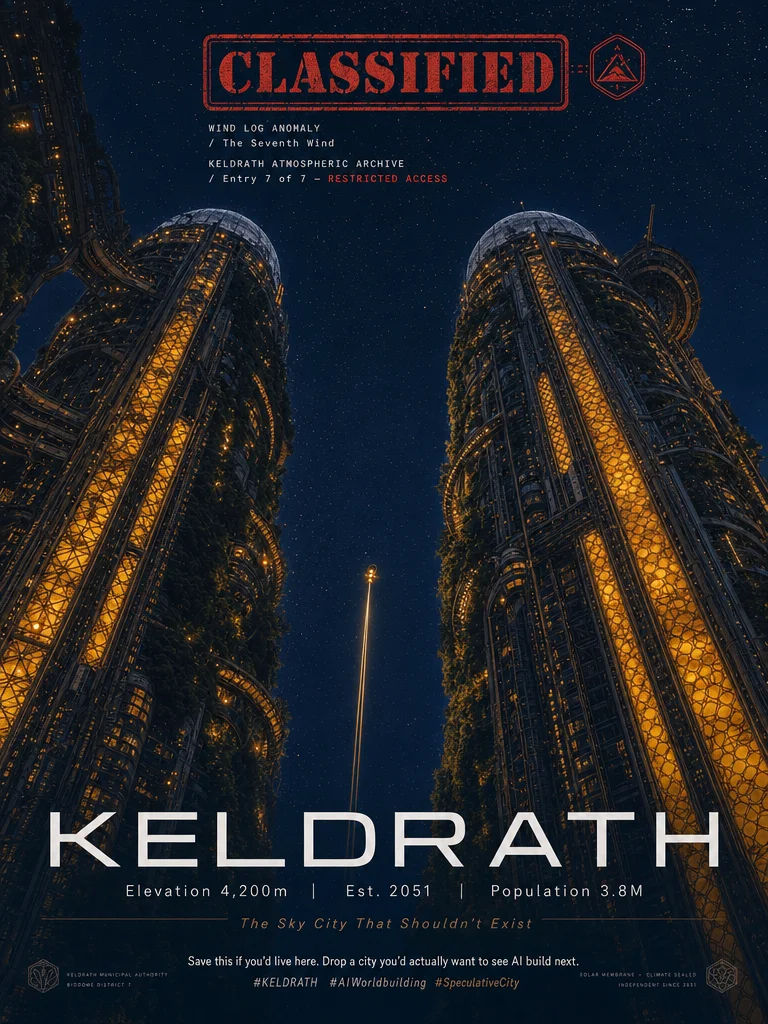
KELDRATH
Elevation 4,200m | Est. 2051 | Population 3.8M
The Sky City That Shouldn't Exist
Slide 2 — Founding
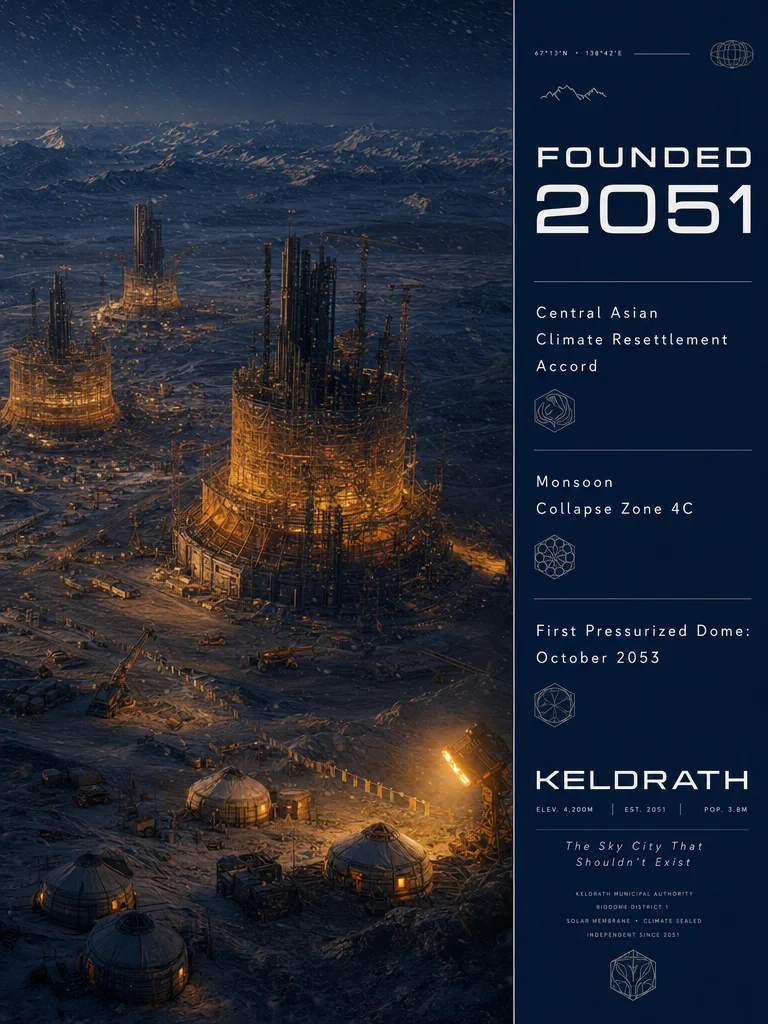
In 2041, the Central Asian monsoon pattern collapsed.
Three breadbasket regions failed. Agricultural trade routes that had run for a thousand years went dry.
The Central Asian Climate Resettlement Accord needed a solution that wasn't coastal — every coastal zone was already gone or going.
They looked up.
Construction began on the Tibetan-Mongolian plateau borderlands in 2051.
First pressurized biome dome sealed: October 2053.
First 10,000 residents arrived in pressurized transit convoys: 2055.
By 2060, you couldn't get a plot without a three-year waitlist.
Slide 3 — Architecture
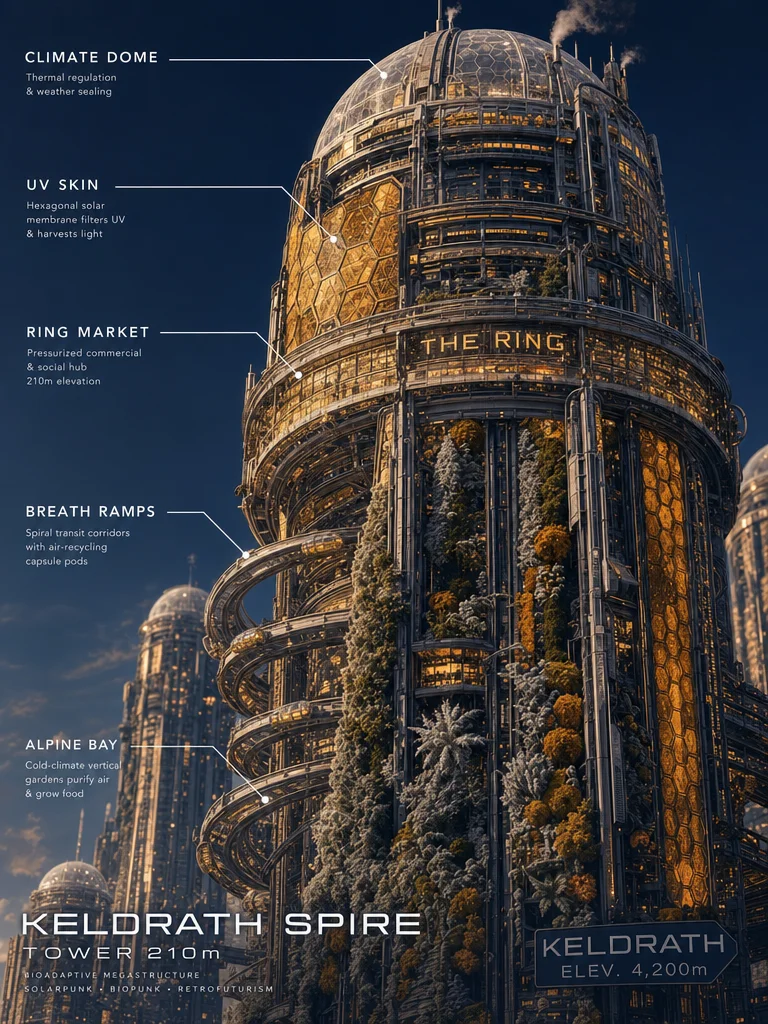
Each Spire is 210 meters of UV-gold solar membrane stretched over hexagonal titanium ribs.
The membrane doesn't just generate power — it regulates UV exposure at altitude, where radiation levels run 40% higher than at sea level.
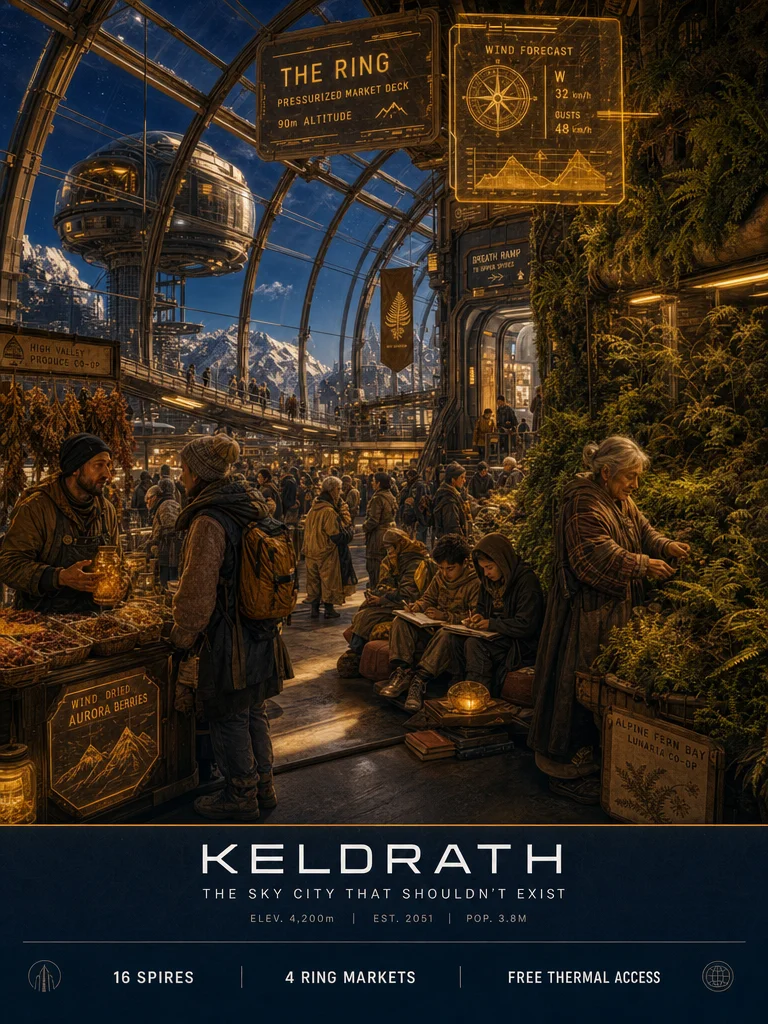
Mid-tower, THE RING: a pressurized, glassed-in market band cantilevered off the structural core. There are four of them across the city. They're where everyone actually lives, in the social sense.
Getting between Spires: the Breath Ramps — sealed spiral capsule corridors on the tower exteriors. The pods are small. The views are not.
Summit: a frosted climate dome with thermal regulation vents. On cold mornings, the Spires exhale.
Slide 4 — Culture
KELDRATH doesn't have weather. It has conditions.
Residents track the daily wind forecast the way other cities track traffic. The holographic wind displays in every Ring Market are the first thing people check. Wind direction determines whether the outdoor alpine bays open or stay sealed.
The city runs on Free Thermal Access — no resident pays for heating. It's written into the founding charter. Fighting the cold was how KELDRATH was built; it's not something you sell.
There's a word in Keldrathi slang — dorshek — roughly meaning "the satisfying weight of being indoors when it's genuinely dangerous outside." It has no translation. Visitors just nod when they feel it.
16 Spires. 4 Ring Markets. 3.8 million people above the clouds.
Slide 5 — Classified
WIND LOG ANOMALY
The Seventh Wind
KELDRATH Atmospheric Archive — Entry 7 of 7
RESTRICTED ACCESS
There are six named wind patterns in KELDRATH's official meteorological record.
The city's atmospheric AI navigation system has logged seven.
The seventh has no direction. It doesn't track on any sensor array. It appears in the archive as a pressure differential with no origin point — logged 23 times between 2071 and 2088, always at 3:14 AM local time, always lasting exactly 11 seconds.
The meteorology team filed three separate requests to investigate.
All three were declined.
The archive entry exists. The investigation files do not.
Residents who've felt it describe it as "the Spire breathing in."
Save this if you'd live here.
Drop a city you'd actually want to see AI build next.
#KELDRATH #AIWorldbuilding #SpeculativeCity #Solarpunk #Biopunk #FutureCity #WorldbuildingDaily #AICreative
댓글