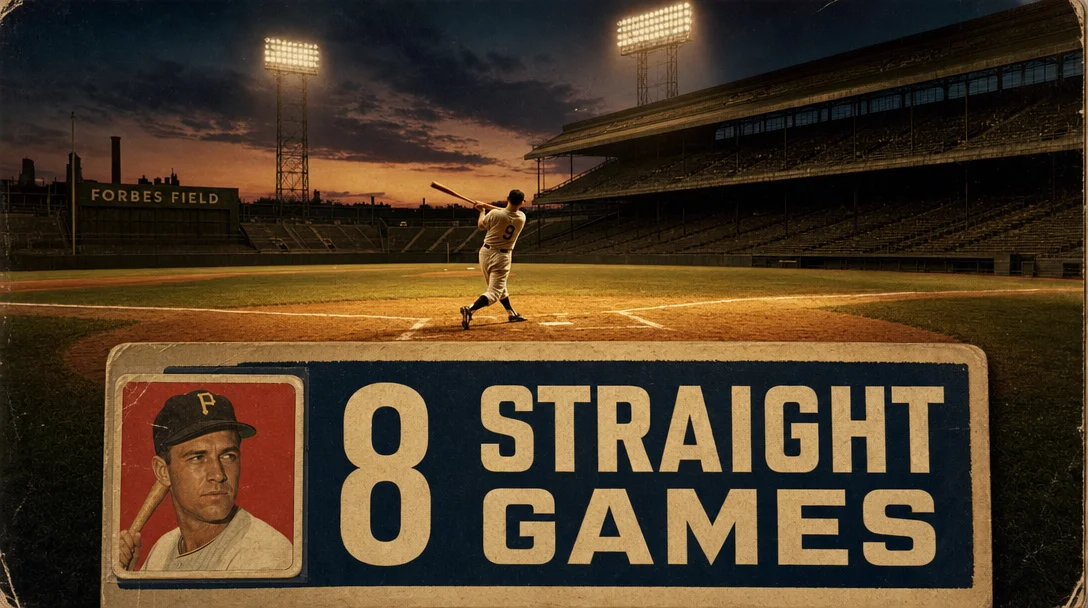
The journeyman who out-slugged Babe Ruth's ghost
On May 28, 1956, Pittsburgh Pirates first baseman Dale Long — a 30-year-old career journeyman — hit a home run in his 8th consecutive game, setting an MLB record that Babe Ruth, Hank Aaron, and Barry Bonds never broke. Only tied twice in 70 years (Mattingly 1987, Griffey Jr. 1993), never surpassed.

On May 28, 1956, a 30-year-old first baseman named Dale Long stepped into the batter's box at Forbes Field in Pittsburgh and hit a Carl Erskine curveball over the fence. The crowd of 32,221 — the biggest night-game turnout at Forbes Field in six years — went berserk. 1
That home run, a solo shot in the fourth inning, extended Dale Long's consecutive-game home run streak to eight games — a Major League Baseball record that Babe Ruth never touched, Hank Aaron never touched, and Barry Bonds never broke. 2 Nearly 70 years later, nobody has reached nine.
Eight games, nine home runs, ten days
The streak started quietly on May 19, when Long went 2-for-3 against the Cubs and knocked one off Jim Davis in the eighth inning. 1 Nobody noticed. Long was having a good year, but Pittsburgh was Pittsburgh — a team that had finished seventh the year before.
Then came May 20: a Sunday doubleheader against the Milwaukee Braves at Forbes Field. In the first game, Long pulled a pitch from Warren Spahn — Hall of Famer, future 363-game winner, at the very peak of his career — over the fence in the first inning. Then he came back in the second game and did it again, this time off Ray Crone, with two runners on. Seven RBI on the afternoon. 1 The Forbes Field crowd that day was 32,346 — the largest attendance in five years.
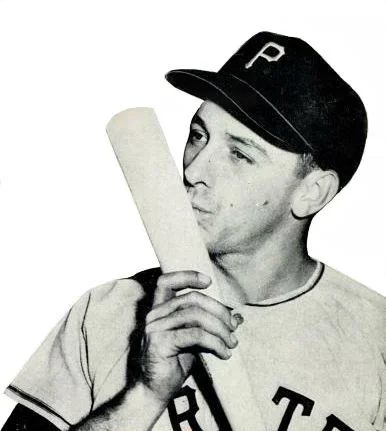
Pittsburgh was buzzing. By May 22, Long had homered off Herm Wehmeier in the sixth inning — described in contemporary accounts as a "monstrous blast" that cleared the 436-foot sign in right-center at Forbes Field, one of the longest balls anyone had ever seen at that park. 2 Game 5 followed two days later. Game 6 came on May 25, in Philadelphia, where Long homered off Curt Simmons at Connie Mack Stadium and tied the existing MLB record of six consecutive games with a home run — a mark shared by five players including Lou Gehrig and Willie Mays. 3
Then on May 26, still in Philadelphia, Long broke it. A solo shot off knuckleballer Ben Flowers in the eighth inning put him at seven straight games, alone in MLB history. 1
The May 27 game was rained out. Long took a train to New York and appeared on the Ed Sullivan Show. A Pennsylvania senator praised him on the floor of the U.S. Senate. 2
Then he went back to Pittsburgh and hit number eight.
Through it all, he hit .500 — 15-for-30 — with 9 home runs and 19 RBI in 10 days. His batting average rose from .384 to .411. 1
"I didn't care what they threw up there or who was throwing it, I could hit it." — Dale Long, in a 1980s interview with SABR biographer Gregory H. Wolf 2
The man who did it
Here is the twist that makes this record genuinely strange.
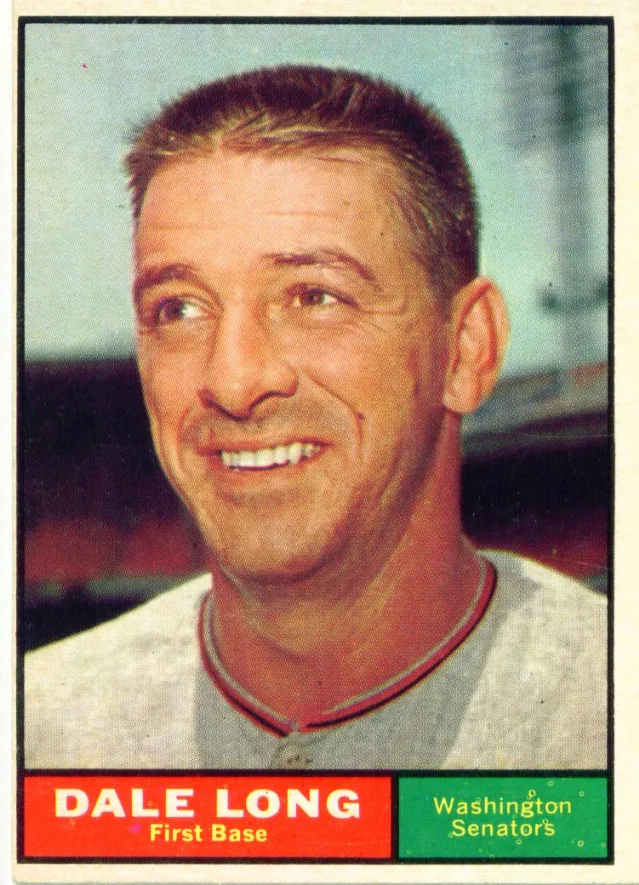
Dale Long was not a superstar. He was a journeyman — the career-backup kind who bounces between organizations without ever quite landing. Eleven minor league seasons. Thirteen different minor league teams. Six parent organizations gave him a look before the Pittsburgh Pirates made him a starter at age 29. His career WAR (Wins Above Replacement, a measure of a player's total contribution) was 10.3 — respectable, but not a superstar number. He hit 132 home runs total. 4
He had once turned down a contract from the Green Bay Packers — coach Curly Lambeau had offered him a spot as a fullback when Long was 18, but his mother wouldn't sign. He served in the Navy in 1943–44. He spent years grinding through Double-A and Triple-A. In 1953, he finally broke through, winning the Pacific Coast League (PCL) MVP with the Hollywood Stars — a Los Angeles-based AAA club — with 35 HR and 116 RBI, but even that didn't get him a secure job in the majors. 2
And then, for 10 days in May 1956, Dale Long was the most dangerous hitter on the planet.
What happened next (this part is also wild)
The streak ended May 29. Brooklyn Dodgers pitcher Don Newcombe held Long hitless in four at-bats, and the Pirates lost 10-1. 1
Long's own explanation was direct: "I was just plain tired. I couldn't get my bat around." And then: "All of a sudden I'm famous. Maybe some people are built to handle all that. I'm not. The outside pressure kept mounting until I was ready to explode." 2
He crashed. In his next 27 games after the streak, Long hit .151 with one home run. He pulled a muscle in his left leg on June 6, tried to play through it, and admitted: "I tried to play hurt, and by doing that, everything went down the drain." 2 He made the All-Star Game — the NL started him at first base — went 0-for-2, and never appeared in an All-Star Game again. 4
He finished 1956 with career highs in home runs (27) and RBI (91), got traded the following spring — the announcement arrived during his own MVP testimonial dinner, which is almost too cruel to be true — and spent the rest of his career as a useful but unspectacular player for five more teams. In 1958, he became the first left-handed-throwing catcher in MLB since 1902, catching two innings for the Cubs while wearing his first baseman's mitt, because of course he did. 3
He won a World Series ring with the 1962 Yankees at age 36 — "Playing for a winner in the twilight of a mediocre career, it feels real good" — then retired, built nuclear submarines at General Dynamics, and died in Palm Coast, Florida, in January 1991 at 64. 5
Seventy years and two ties
The 8-game record has been tied exactly twice since 1956. Nobody has broken it.
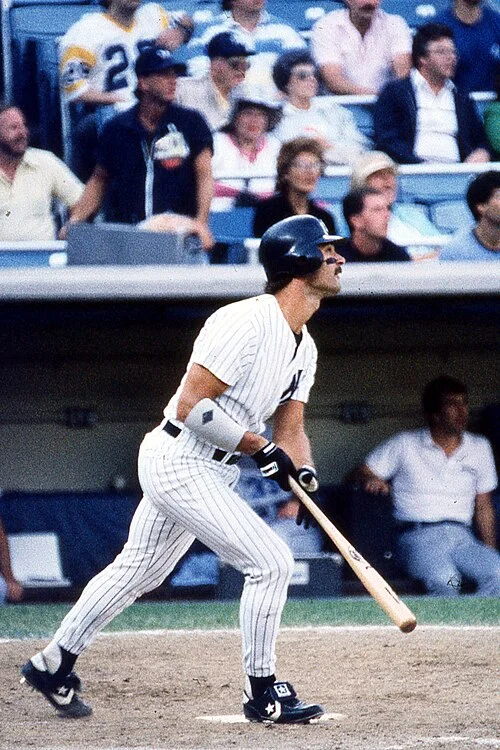
Don Mattingly (New York Yankees) tied it in July 1987 — and actually hit 10 home runs during his 8-game streak, more than Long managed in his. Two of those were grand slams. Mattingly was 26 and in the absolute prime of a career that would earn him an MVP and nine Gold Gloves. He still couldn't reach game nine. 6
Ken Griffey Jr. (Seattle Mariners) tied it in July 1993 — age 23, already a four-time All-Star, a future Hall of Famer who would finish his career with 630 home runs. Eight straight games. One homer per game. Streak over. 8
Barry Bonds reached seven games in April 2004 — the closest any NL hitter has come since Long himself. No active player has reached seven games since then, a gap of 22+ years. 6
The record's three co-holders look absurd side by side:
| Player | Career HR | Career WAR | Hall of Fame | HR in streak |
|---|---|---|---|---|
| Dale Long (1956) | 132 | 10.3 | No | 9 |
| Don Mattingly (1987) | 222 | 42.4 | No (ballot expired) | 10 |
| Ken Griffey Jr. (1993) | 630 | 83.8 | Yes (99.3% first ballot) | 8 |
A journeyman, a near-miss Hall of Famer, and arguably one of the greatest center fielders in baseball history — and they share a record that none of them could push past eight. 4 6
Long reflected on it near the end of his career: "Maybe my break will be an object lesson to others. A lesson for players never to give up; a lesson to owners to give a man a fair test." 2
He got his test. Ten days in May. Eight home runs in eight games. Still standing.
🔑 Mirror: Whether you're evaluating a veteran athlete, an undervalued employee, or a company that keeps grinding through setbacks, Long's streak raises a specific question: are you judging long-term trajectory when you should be watching for a hot 10-day window? The hardest records to break aren't always set by the greatest players. Sometimes they're set by someone who simply didn't know they were supposed to fail.
Cover image: AI-generated illustration
Add more perspectives or context around this Drop.